|
| "What in the world have they been teaching you at that college?!" |
This is funny stuff, especially since it's meant to be a somber wake-up call. Where to start?
First, talk radio host Dennis Prager offers nothing but a few anecdotes to prove his point, which is probably evidence aplenty for his conservative audience. But is there any real evidence that so many young adults are rejecting their parents' values?
Americans of every age, gender, political party, and region overwhelmingly say that "family" is most important to them, far more so than religion, work, community, or politics. Interestingly, such devotion to family is actually 13 points higher in the "liberal" northeast than in the "heartland" Midwest.
Love of family seems pretty conservative to me. And there's more:
Religion isn't the source of our division, either: 80 percent of Americans say religion is fairly or very important in their own lives, and almost 90 percent say they believe in God.
Meanwhile, 60 percent of Americans still find abortion morally objectionable.
So if it's not Americans' strong love of God and family that bothers Prager, perhaps this is?:
According to the poll, large majorities of Americans now say that contraception, interracial marriage, sex education in schools, unmarried cohabitation, stem cell research, gambling, and divorce are morally acceptable. Even pre-marital sex and having children out of wedlock are morally acceptable to the majority of Americans under 65, and homosexuality is morally acceptable to the majority under 45. While marijuana is still about a draw (47 percent morally acceptable to 51 percent morally objectionable), for the most part what used to be "counterculture" is now, simply, culture.
Aha! That's Sodom and Gomorrah alright!
That leads to my second point. Prager avers that rejection of traditional values by the yutes has been happening "for at least two generations" now. A generation is 25 years, so that puts us back at 1963. Prager's Wikipedia page says he was born in 1948, meaning he was a teenager in the 1960s and a young man in the 1970s.
I seem to recall some interesting cultural stuff happening in the 60s and 70s... we read about it in high school once.... Oh yes! The counter-cultural revolution, free love, feminism, rampant drug use, riots, protests, bombings.... Gee, I guess all that happened on Pragers' parents' watch. Why didn't they put a stop to Prager's misbehaving? It makes you wonder... Is Prager really rejecting his own generation?
I mean, compare the youth of the 60s and 70s with the youth of the 90s and 00s. They're apples and oranges. As Fareed Zakaria recently noted, "[C]ompared with almost any period in U.S. history, we live in bourgeois times, in a culture that values family, religion, work and, above all, business."
Read just about any survey of Millennials, or heck, go talk to one, and you'll find kids not just respectful of their parents, but downright reverent of adults. Moreover, "Millennials pray about as often as their elders in their own youth," according to Pew research, and, "Millennials (like older adults) place parenthood and marriage far above career and financial success."
It gets worse for Prager -- I mean, better:
They respect their elders. A majority say that the older generation is superior to the younger generation when it comes to moral values and work ethic. Also, more than six-in-ten say that families have a responsibility to have an elderly parent come live with them if that parent wants to. By contrast, fewer than four-in-ten adults ages 60 and older agree that this is a family responsibility.
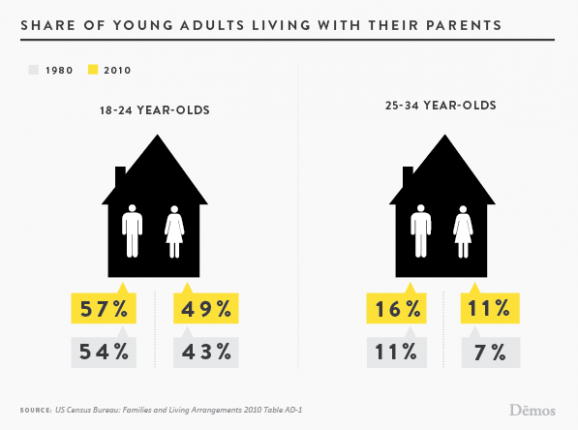
In fact, Millennials' biggest fear is an authority figure's disapproval (or failure to pat them on the back); and their greatest ambition is to live just like their parents (although few hope to live better). So it seems odd for Prager to cry "hell in a hand basket!" with such a crowd of fine, upstanding kids co-habitating in their parents' basements.
What gives? Well, I'd wager it has something to do with Prager's handsome head of white hair and 65 years of age. It's easy to forget the way we were. It's also related to his bio: he's always had his nose in a book. Prager was studying Russian and Hebrew while his coevals were screwing, smoking weed, dropping acid and dropping out. It seems to me his real problem is that his generation -- or at least the better parts of it -- changed American history for good. And true conservatives like Prager, as we all know, "stand athwart history, yelling Stop, at a time when no one is inclined to do so or to have much patience with those who so urge it."
So in that sense, Prager is a true conservative, because nobody is now so inclined to roll back the cultural changes of the 60s and 70s. Back then Prager should have done more standing athwart: he ought to have have studied less and cracked hippy skulls more.
Personally, I don't see how our culture could possibly go much farther to the Left. OK, gay marriage and twerking are new ones, but... in America's history we've been a lot more decadent, culturally and morally. (For a total historical eye-opener, check out The Way We Never Were).
And never ever in the history of mankind have our children been so well-protected and fretted over as they are in today's USA. The whole country has practically become one big daycare center; it's completely child-friendly.
Although... if you want actual daycare for your kids you'll have to get a second job and go into debt, because it's more expensive than college. It's a shame that Prager and other "sad conservative parents" in their 50s and 60s aren't more upset about that! But why should they be? Their privileged kids are all grown up and in college now being indoctrinated in Lenin, Marx and Lady Gaga....
And this brings me to my third and final point: values are not the same as political affiliation. Certainly the two are related, but not always the same. Here's Prager's real beef with today's yutes, I suspect:
To be sure, Millennials remain the most likely of any generation to self-identify as liberals; they are less supportive than their elders of an assertive national security policy and more supportive of a progressive domestic social agenda. They are still more likely than any other age group to identify as Democrats.
Noooooo! Anything but that!
Well, sorry to break it to you, Prager and Mom & Dad, but it is indeed possible to pray often, honor your parents, love your country, get jazzed about private enterprise and still be a liberal Democrat. Now go grab some kleenex before your kids see you like this.
By Dennis Prager
November 5, 2013 | National Review
There is a phenomenon that is rarely commented on, although it’s as common as it is significant.
For at least two generations, countless conservative parents have seen their adult children reject their core values.
I have met these parents throughout America. I have spoken with them in person and on my radio show. Many have confided to me — usually with a resigned sadness — that one or more of their children has adopted left-wing social, moral, and political beliefs.
A particularly dramatic recent example was a pastor who told me that he has three sons, all of whom have earned doctorates — from Stanford, Oxford, and Fordham. What parent wouldn’t be proud of such achievements by his or her children?
But the tone of his voice suggested more irony than pride. They are all leftists, he added wistfully.
“How do you get along?” I asked.
“We still talk,” he responded.
Needless to say, I was glad to hear that. But as the father of two sons, I readily admit that if they became leftists, while I would, of course, always love them, I would be deeply saddened. Parents, on the left or the right, religious or secular, want to pass on their core values to their children.
As a father, I have as my purpose not to pass on my “seed” but to pass on my values. Just about anyone can biologically produce a child. That ability we share with the animals. What renders us distinct from animals is that we can pass on values. As the Latin puts it, animals have only “genitors,” while humans have “paters.” Or, as the Hebrew has it, parent (horeh) comes from the same root as teacher (moreh). That is why Judaism puts teachers (of religious and moral values) on the same plane as parents.
So it is sad when a parent who believes, for example, in the American trinity of “Liberty,” “In God We Trust,” and “E Pluribus Unum” has a child who believes that equality trumps liberty, that a secular America is preferable to a God-centered one, and that multiculturalism should replace the unifying American identity.
It is sad when a pastor or any other parent who believes that the only gender-based definition of marriage that has ever existed — husband and wife — has a child who regards the parent as a bigot for holding on to that definition.
It is sad when a parent who believes that America has always been, in Lincoln’s famous words, “the last best hope of earth” has a child who believes that America has always been little more than an imperialist, racist, and xenophobic nation.
That this happens so often raises the obvious question: Why?
There are two reasons.
One is that most parents with traditional American and Judeo-Christian values have not thought it necessary to articulate these values to their children on a regular basis. They have assumed that there is no need to because society at large holds those values, or it did so throughout much of American history. Villages do indeed raise children. And when the village shares parents’ values, the parents don’t have to do the difficult work of inculcating these values.
But the village — American society — has radically changed.
Which brings us to the second reason.
Virtually every institution outside the home has been captured by people with left-wing values: specifically the media (television and movies) and the schools (first the universities and now high schools). In the 1960s and 1970s, American parents were blindsided. Their children came home from college with values that thoroughly opposed those of their parents.
And the parents had no idea how to counteract this. Moreover, even if they did, after just one year at the left-wing seminaries we still call universities, it was often too late. As one of the founders of progressivism in America, Woodrow Wilson, who was president of Princeton University before he became president of the United States, said in a speech in 1914, “I have often said that the use of a university is to make young gentlemen as unlike their fathers as possible.” Eighty-eight years later, the president of Dartmouth College, James O. Freedman, echoed Wilson: “The purpose of a college education is to question your father’s values,” he told the graduating seniors of Dartmouth College.
Even now, too few conservative parents realize how radical — and effective — the university agenda is. They are proud that their child has been accepted to whatever college he or she attends, not realizing that, values-wise, they are actually playing Russian roulette, except that only one chamber in the gun is not loaded with a bullet.
And then the child comes home, often after only a year at college, a different person, values-wise, from the one whom the naïve parent so proudly sent off just a year earlier.
What to do? I will answer that in a future column. But the first thing to do is to realize what is happening.
There are too many sad conservative parents.