Showing posts with label underemployment. Show all posts

Sunday, February 9, 2014

The myth of Obama's part-time workforce

Here's a graph from Derek Thompson that shows how U.S. part-time employment rises and falls, historically, in perfect sync with recessions and recoveries:


That's right.  No negative Obamacare effect at all.  Zilch.  In fact, Thompson notes that, "in the last year, new full-time jobs outnumbered part-time jobs by 1.8 million to 8,000. For every new part-time job, we're creating 225 full-time positions."  

Here's how Thompson sums how badly many journalists are skewing economic reality:

It is a free country, and journalists have every constitutional right to claim that we're moving toward a Part-Time America. They will, however, be in the uncomfortable position of making a falsifiable statement that has been relentlessly falsified by every available statistic. The entire increase in part-time employment happened before Obamacare became a law.

Wherefore the dastardly lib'rul media when we need them?


By Derek Thomson
February 7, 2014 | The Atlantic

Sunday, June 30, 2013

MB360: Record-high delinquency of student loans

I don't necessarily agree with MB360 that student loan debt is a "bubble" in the sense that speculation is driving up prices beyond any underpinning value.  A few weeks ago, Law professor Charles J. Reid explained why:

Student loans, however, are not like this, for the simple reason that they are non-dischargeable in bankruptcy. They are not a bubble and cannot become one. What they can become -- and show increasing signs of actually becoming -- is an anchor that is sinking the fortunes of an entire generation.

But just because they're not a bubble doesn't mean these levels of indebtedness are not extremely worrying. They are.  These delinquency rates mean that graduates are not getting the kinds of jobs they thought they would get thanks to their expensive degrees.  If higher education is not the key to employment and higher income, then what is?  So far, our nation does not have another answer.


By mybudget360 
June 30, 2013

If the news for college graduates couldn’t get any better.  Our woefully motivated millionaire Congress is unable to figure out what is necessary to stop the doubling of interest rates on student debt.  While the Fed can turn on a dime to rectify zero percent interest rates for member banks, trying to help the youth of the nation well, that is just too hard to do.  Milling around through the data I found that for the first time in history, student debt had the highest delinquency rate of all household debts.  This is a big deal given that Americans now carry over $1 trillion in student debt and most of it is in the hands of the young.  At the nucleus of this argument is that people are going into too much debt to finance their educational pursuits.  Collecting tips at the Olive Garden is not exactly going to payoff that $50,000 in student debt.  How is it that the Fed can subsidize big banks with zero percent rates so they can speculate in real estate and other ventures while college graduates are now faced with the doubling of interest rates?

Half of college graduates not utilizing degree

Part of the problem is the voting power (or lack of it) from younger Americans.  Many simply do not vote.  And the baby boomer cohort is guiding many policies through elected officials although they only serve a tiny pizza slice of the baby boomers at that.  So with that said, the voice of the young is largely drowned out by big business and higher education has turned into a very lucrative private-public venture.  With that as our backdrop, half of college graduates are not utilizing their increasingly more expensive degrees:
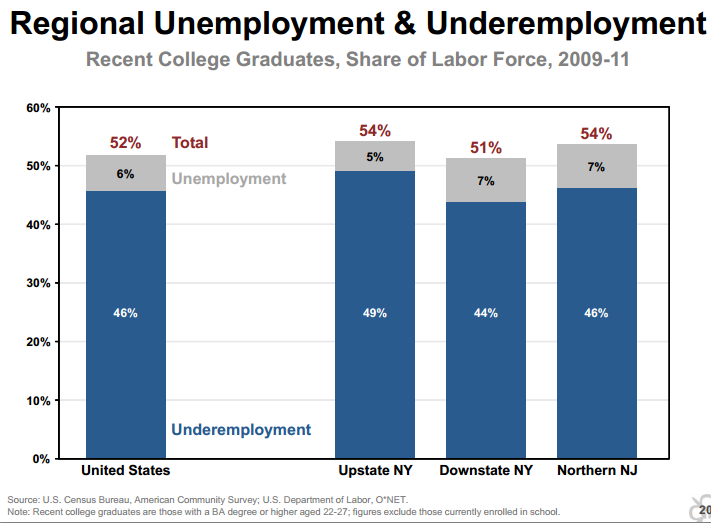
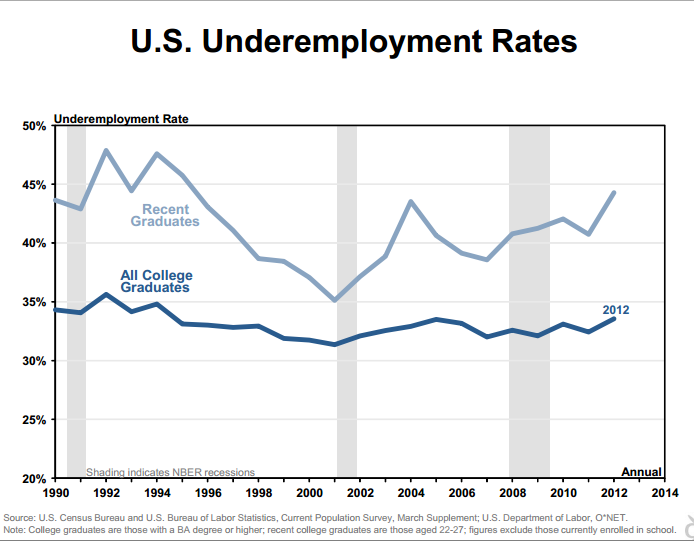
college graduates underemployed

Half of recent college graduates are either unemployed or underemployed.  And recently many have given up on pursuing careers where their degrees would be utilized and have taken up other jobs.  Other jobs that would have gone to lower skilled workers.  And of course, these workers get pushed down into a lower level of the economic ladder.  And what a shocker that as we go into the various levels of Dante’s Economic Inferno we find that 47.7 million Americans are on food stamps.

The above chart is rather sobering because many recent graduates are leaving school with high levels of debt.  Incomes for many of these graduates are not justifying the sky high rates of tuition at many schools.  Education is still a worthy venture and that is why people continue to go into high levels of debt for this.  Yet our banking system has been rather obsessed with one sector of our economy since the tech bubble burst in the early 2000s.  Real estate has seemed to dominate every big decision in the last decade to the detriment of creating an economy where millions of jobs are added to meet this more educated workforce.  That has clearly not happened.  Colleges are not going to turn their back on willing students with fresh loans in hand.  And I suppose that is the point.  Easy access to debt is like an aphrodisiac for the industry.  Go to any college campus and you will see palatial stadiums and massive buildings.  Do Olympic sized pools make people discover cures for modern diseases quicker?

What is even more troubling is that the underemployment rate for recent college graduates has trended up in the last few years while the overall unemployment rate has fallen:

recent college grad data

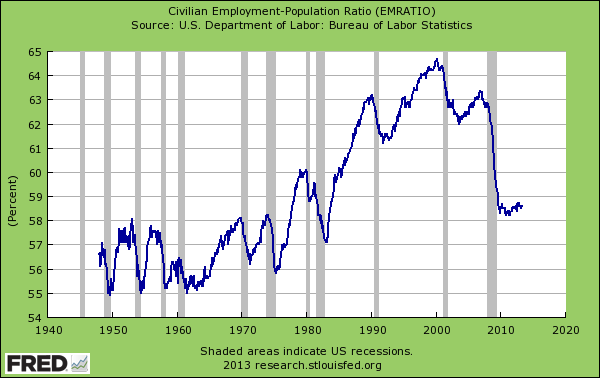
No, we are not looking at a chart of Spain or Greece but a chart of US recent graduates.  A large part of the decline in the unemployment rate has come because the civilian employment population ratio continues to lower:

civilian pop ratio

While many older Americans have dropped off the radar, many recent graduates simply do not have this option.  Many over the last few years have clearly opted to take on jobs that are underutilizing their degrees.  Does that mean they overpaid for their education?  $1 trillion in student debt seems to give us an answer that not only did many overpay, they didn’t even have the funds to afford it in the first place.  Higher tuition would make more sense if wages were also rising but that doesn’t seem to be the case with the new batch of graduates.  And many are falling into student debt quicksand and are unable to pay the loans they now have.

The most delinquent of them all

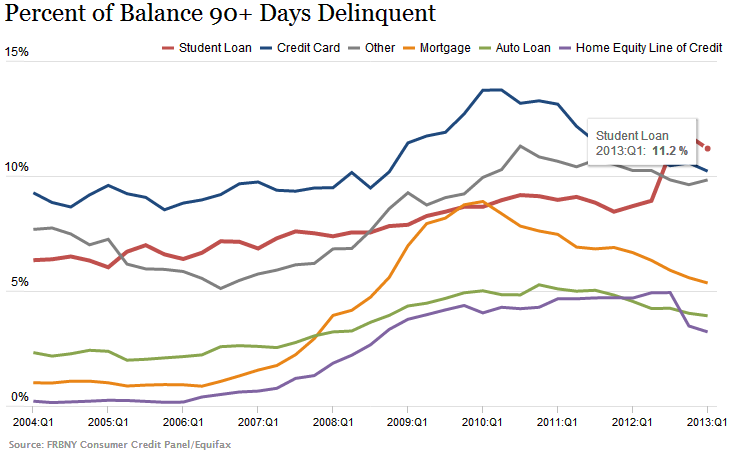
Student debt before the 2000s hit was typically a safe financial bet.  Delinquencies on student debt reflected this.  Today, we now find ourselves at the precipice of another bubble with student debt having the highest delinquency of any form of household debt:

student loan bad debt

You can see this rate doubling only in the last few years.  Keep in mind this is occurring without the potential doubling of student loan interest rates.  Rates are set to go from 3.4 percent to 6.8 percent if Congress does not act.  Amazingly, they are able to act quickly when it comes to the interest of large banking but to help the young in our nation?  No, let us go on holiday break and see what happens.

The rising delinquency rates are simply the last straw in the student debt bubble.  This is a bubble.  When you have prices soaring without any underlying economic change, you have a big problem on hand.  Keep in mind that what you can afford and the price of something are fully disengaged since the government will lend pretty much whatever is necessary to go to school.  If the cap was $100,000 a year, you can rest assured you will have some for-profits cropping up with $100,000 a year degrees.  Record delinquencies and half of recent graduates working in jobs where a massively expensive degree is not being used does not bode well for higher ed at the moment.  No one has a crystal ball on how this will play out but you can rest assured that something is going to give.  You don’t need a college degree to figure that one out.

Monday, February 13, 2012

MB360: United States of Dollar Stores


Posted by mybudget360
February 12, 2012

Before 2000 dollar stores were largely seen as a bazaar of quirky trinkets and plastic oddities. Many sold excess volume of products, even selling old Super Bowl t-shirts of teams that did not win. Yet the dollar store of today is not the one of even one decade ago. The disillusionment of the middle class and the rise of a low-wage American worker base have created a booming business for dollar stores. Customers from more affluent backgrounds are now shopping at these stores because of an economic caution about their declining purchasing power. Even in the midst of the boom in the stock market we still have over 45,000,000+ Americans receiving food assistance. I talked about this large segment of our population in EBT Nation. What does the rise of the dollar store tell us about the future of the American economy?

Dollar Store growth

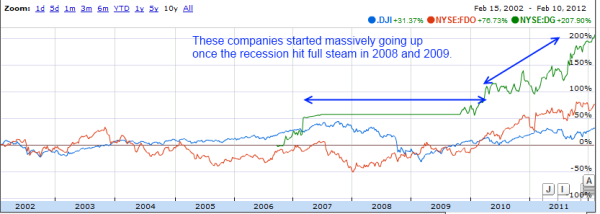
Dollar stores have been around for many decades but the surge in big name dollar stores really hit a full head of steam once the recession arrived:

dollar general and family dollar chart stock

You can see that the two leading dollar stores, Dollar General and Family Dollar hit full stride after 2008. This is a billion dollar business that is benefitting from the weakness in the overall economy. As more income is concentrated in fewer hands, the middle class gets squeezed down and with trillion dollar bailouts targeted at the financial sector, many Americans are seeing their purchasing power dwindle. Yet this compression is not felt as heavily at dollar stores where many can live large with a declining dollar, even if it is only for a brief shopping experience.

Part of this growth also comes from our persistently high unemployment rate:

unemployment us 2012

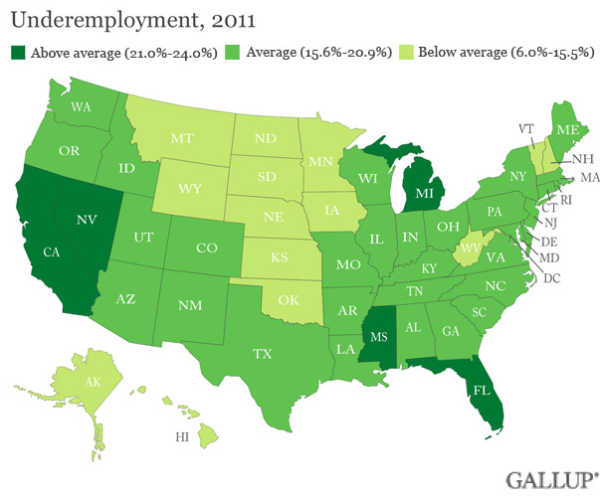
5 states still have underemployment rates that are above 20 percent. So even though jobs are being added many are being added in lower-wage service sector fields. 5 million good paying jobs were lost since the recession hit and only about 1 million have been recovered.

Impact of compressing middle class on dollar stores

One of the surprising trends with dollar store growth comes from more affluent Americans becoming customers:

"(NY Times) Financial anxiety — or the New Consumerism, if you like — has been a boon to dollar stores. Same-store sales, a key measure of a retailer's health, spiked at the three large, publicly traded chains in this year's first quarter — all were up by at least 5 percent — while Wal-Mart had its eighth straight quarterly decline. Dreiling says that much of Dollar General's growth is generated by what he calls "fill-in trips" ­— increasingly made by wealthier people. Why linger in the canyons of Wal-Mart or Target when you can pop into a dollar store? Dreiling says that 22 percent of his customers make more than $70,000 a year and added, "That 22 percent is our fastest-growing segment."

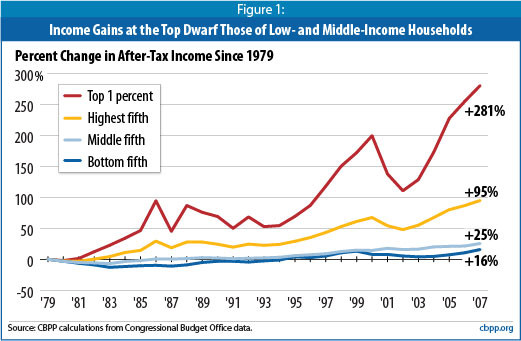
I found this trend intriguing but this stems from the fact that most average Americans are seeing a compression to their real wage growth:

growth-in-income-inequality

The fastest growing segment of dollar store customers are coming from those making $70,000 a year or more. In fact, 1 out of 5 dollar store shoppers come from this group. Keep in mind the median household income in the US is $50,000 and those that make $70,000 a year or more are in the top 35 percent of households.

This also plays into the reality of those lower-wage service sector jobs being added:

"This growth has led to a building campaign. At a time when few businesses seem to be investing in new equipment or ventures or jobs, Dreiling's company announced a few months ago that it would be creating 6,000 new jobs by building 625 new stores this year. Kiley Rawlins, vice president for investor relations at Family Dollar, said her company would add 300 new stores this year, giving it more than 7,000 in 44 states."

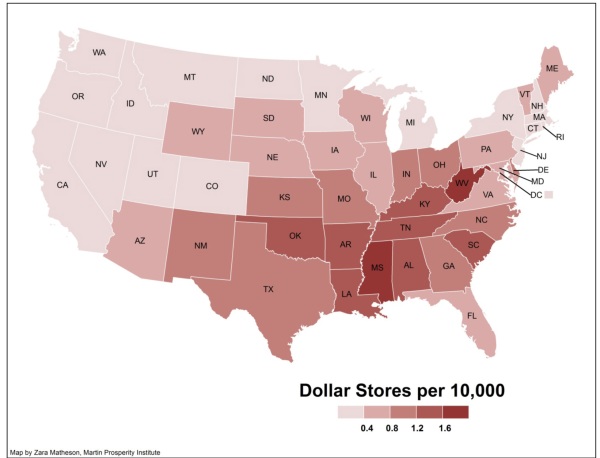
If you look at where dollar stores are most prevalent you will find them all across the country but they are most prevalent in the South:

dollar stores us

The rise of the dollar store goes hand and hand with the loss of the middle class in America. The largest customers at dollar stores are still those with lower incomes, households making $40,000 a year or less make up nearly half the customer base. But when this pool continues to grow you have business growth and that is what we are seeing here. The average per capita income in the US is $25,000 which doesn't go far given the cost of healthcare, energy, and education.

It is also fascinating to see that 40 to 45 percent of dollar store items now come from big name brand companies. This industry is now a multi-billion dollar industry. I've driven around and see Subway and KFC for example now having marketing material showing "EBT accepted here" and dollar stores with a large and growing segment of their aisles made up of by food, are seeing a boon in this economy. I mean think about it with 45,000,000+ Americans receiving food assistance this is a large customer base. You also have many retirees who heavily rely only on Social Security stretching their declining buying power at these stores. Even with low profit margins business can be good. Not sure if we should be thrilled that dollar stores are one business segment that is booming in our modern day economy.