Showing posts with label student debt. Show all posts

Tuesday, September 3, 2013

Sirota: Higher education should be a right like high school

Following up on Matt Taibbi's expose of the scam that federal student loans have become, David Sirota offers us an alternative [emphasis mine]:

Just consider the critical difference between how high school and college education programs are funded.

The former is funded by broad-based taxes and few would ever suggest changing it to an individual tuition system. Why? Because we've come to view access to high school as a right. This view is based not just on notions of morality but also on an economic calculation. Basically, we know we need a workforce with as many high school graduates as possible, and we've decided that forcing young people to go into crushing debt to get a high school degree would deter many from getting the degree.

Yet, even though we know that higher education is also increasingly an economic necessity, we do not have the same funding model or outlook for college. Instead, we still predicate access to higher education on a student's wealth and/or their willingness to go into crushing debt.

[...]  No doubt, shifting our policies to treat post-secondary education as equally necessary as high school -- and therefore worthy of similar fiscal treatment -- requires a paradigm shift in thinking.

It requires us to see higher education as not just 4-year university programs, but also 2-year community college programs and vocational and technical education.

As I've been saying for years, we can give millions of Americans marketable, in-demand job skills without four-year colleges.  For too many, four years of college is an extravagant waste of time and money; they don't want or really even need to be there, (hurting the college experience for those who do); they just need a piece of paper at the end that generically qualifies them for gainful employment.


By David Sirota
August 29, 2013 | Alternet

Tuesday, August 27, 2013

Taibbi: College loan system scam

Better late than never, I'm posting this exposé by Taibbi about the exorbitant cost of U.S. higher education.

Today's graduates leave college with have an average of $27,000 in student loan debt.


As Taibbi reveals, 

... the dirty secret of American higher education is that student-loan interest rates are almost irrelevant. It's not the cost of the loan that's the problem, it's the principal – the appallingly high tuition costs that have been soaring at two to three times the rate of inflation, an irrational upward trajectory eerily reminiscent of skyrocketing housing prices in the years before 2008.

Another dirty little secret is that the federal government, by its own estimates, stands to make $185 billion in profit on student loans over the next 10 years. Boosting the government's profits, borrowers cannot discharge their student loan debt through personal bankruptcy. The Department of Education can even garner federal disability checks!

So why is college so expensive in America?  The knee-jerk conservative response is: tenured ivory tower professors; and money for Democrats from the education lobby.

The former is untrue and the latter is only partly true.  But conservatives should note that the federal student loan system does cause a kind of market distortion, the so-called "Bennet hypothesis," named after conservative William Bennett: with any accredited college eligible to receive students with federal financial aid, there is really no incentive for colleges to cut costs, compete, or focus on degrees that give students a decent Return on Investment (ROI).  

"A degree in bullshit" does the job for both colleges and the government lender when the collection rate on student loans can exceed 100 percent.

And as we all know, the newer for-profit colleges have been gaming the student loan system -- as well as the education allowances given to members of the U.S. Military -- for several years now, even as students at for-profit colleges have a loan default rate as high as 40 percent.

Another reason colleges are so expensive is what Taibbi calls "gilding": the expensive administration buildings, sports stadiums and celebrity professors. These used to be paid for by nervous, eager parents... until they ran out of money. Now the federal government subsidizes colleges. So why shouldn't colleges go on a spending spree?


By Matt Taibbi
August 15, 2013 | Rolling Stone

Wednesday, August 21, 2013

MB360: Americans unprepared for retirement

MB360 brings us some shocking figures on U.S. retirement savings:


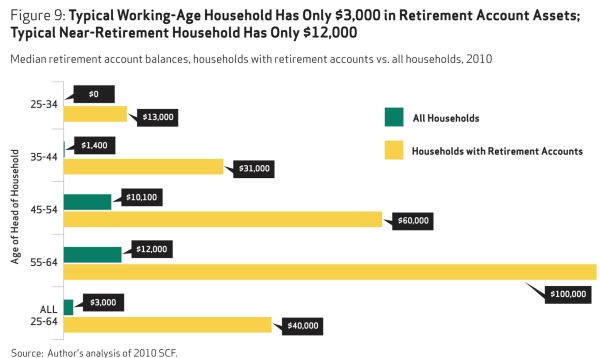
retirementcrisisJ


What we find in the above chart is that most Americans are flat broke when it comes to saving for retirement.  You might say that those 25 to 34 years of age have simply avoided dealing with the future.  However, this is the most indebted young cohort of Americans we have ever seen largely due to student debt.  Yet look at the other age brackets.  The median amount saved for those 35 to 44 is $1,400 (one month of rent and food in many parts of the country).  Those 45 to 54 do a little bit better coming in at $10,100.  Those 55 to 64?  About $12,000.

In total, the median saved for retirement by all US households is $3,000.

Even those with retirement accounts (obviously a small figure) have a median amount saved of $40,000.  The $3,000 figure should shock people into realizing that programs like Social Security are going to become the default “retirement plan” for millions.


But should we really be surprised?  How many U.S. generations have experienced what is now considered a real, comfortable retirement, where savings combined with Social Security and Medicare allowed them to live out the last 20 or so years of life in comfort and security?  One generation?  The Baby Boomers are entering retirement now.  Let's see how well they do.  But it doesn't look good for them, not good at all. 

We need to re-think classical retirement, which is not classical at all, just an ideal that one or two generations of Americans managed to enjoy, and which now, thanks to demographics and cuts to Social Security, the Great Recession, fewer pensions and rising health costs, will soon cease to exist entirely.  


Posted by MB360
August 21, 2013

Friday, August 16, 2013

No accident U.S. is most unequal

I'll continue to hammer away at America's growing wealth inequality that is here by design, not by accident. What do I mean? 

One the one hand, we have government policies that help out the rich: the tax code (that gives U.S. corporations an effective tax rate lower than any official rate among G-20 countries, encourages overseas outsourcing and offshoring of incomefavors capital gains and executive stock options over wages, protects 401-k and IRAs for rich people who save anyway, and has dramatically lowered inheritance tax over the past 30 years); deregulation of banking combined with the $30 trillion TBTF bank bailouts; deregulation of health, safety and environmental codes; fraudulent H1B visas that displace U.S. workers to cut corporate costs; and allowing more money -- and more independent money -- into our elections.  

One the other hand, we have government policies that hurt workers and the poor: a regressive tax system that targets workersSocial Security cutslaws against unions; public transportation fee hikes and service cutspublic employment cutspublic education cutsfalling real minimum wage; and exploding student debt that is immune from personal bankruptcy.

Some anti-worker policies are well-intended. For example, cities often seek to outbid each other with ever-growing subsidies and tax breaks to attract large retailers that promise job creation... with the unintended effect of ruining local mom-and-pop businesses that used to offer better wages and benefits -- wages and benefits that never come back -- and degrading their local tax base.  

We Democrats and liberals can't ignore inequality or its root causes and hope they go away, or fear accusations of "class warfare" for our speaking out. Class warfare is already being waged against the poor and working class, whether we admit it or not.


By Mark Gongloff
August 15, 2013 | Huffington Post

Hey, who says America is in decline? The U.S. is still more awesome than the rest of the world at making at least one thing. And that thing is income inequality.

new paper by economists Facundo Alvaredo, Anthony B. Atkinson, Thomas Piketty, and Emmanuel Saez lays out just how much better at making inequality the U.S. is than everybody else and tries to explain how it got that way.

Since the 1970s, the top 1 percent of earners in the U.S. has roughly doubled its share of the total American income pie to nearly 20 percent from about 10 percent, according to the paper. This gain is easily the biggest among other developed countries, the researchers note. You can see this in the chart below, taken from the paper, which maps the income gains of the top 1 percent in several countries against the massive tax breaks most of them have gotten in the past several decades. (Story continues after chart.)


The higher the dot, the more income inequality has grown in that country. See the red dot waaaay up in the left-hand corner, far away from everybody else? That is the United States, where the top earners have made more while getting their taxes slashed by over 40 percent.

This echoes an OECD study from earlier this year that found the U.S. had the highest income inequality in the developed world. It followed only Chile, Mexico and Turkey among all nations.

So how did America get so darn great at ratcheting open the chasm between the haves and have-nots? Thank the dynamic duo of Wall Street and Washington, which have been working so well together for the past few decades to make laws that favor banks. Turns out this Axis Of Making It Rain has also been making laws that favor the exorbitantly wealthy. Win-win. Unless you are poor, in which case: Sorry, be born to richer parentsnext time, maybe?

One thing you'll notice in this chart is that, typically, the bigger the tax cuts given to the 1 percent (the horizontal scale on the chart), the bigger the income inequality. This is consistent with other studies that have shown the tax code has a big effect on income distribution. That's one way Washington has boosted inequality: By slashing taxes on the rich, for freedom and growth and trickling down on the poor. Unfortunately, the paper points out, contrary to what you will hear from conservatives, lower tax rates on the wealthy offer no obvious benefits to growth, or to the poor.

One other thing you'll notice from the chart is that the United Kingdom has slashed taxes on the top 1 percent almost as aggressively the U.S. has, and yet the share of income going to the top 1 percent is not nearly as big. So there's something else going on here besides just tax breaks.

That something is Wall Street, more or less, as Matthew O'Brien of The Atlantic points out. The same politicians that have busily been slashing taxes on the wealthy have also been loosening fetters on banking, allowing the financial sector to swell to bloated size and mop up ever-more income while contributing ever-less back to the economy. Again, this is consistent with other studies that have attributed much of the rise in in inequality to the pay being sucked up by bankers and overpaid CEOs.

At the same time, U.S. lawmakers have also made it easier and more tax-friendly for the wealthy to pile up more capital gains on their investments. As O'Brien puts it, "The top 1 percent leveraged itself to the market, and haven't looked back."

One nifty benefit to having nine metric craptons of money is that you can use it to buy politicians to help you craft the laws you like, particularly those that will help you end up with 10 metric craptons of money. The poor and middle class, meanwhile, just get ever more discouraged about the political system and stop bothering to fight it, increasingly turning the whole process over to the wealthy and the politicians they own, according to arecent paper by Frederick Solt at Southern Illinois University. Sound familiar?

Sunday, June 30, 2013

MB360: Record-high delinquency of student loans

I don't necessarily agree with MB360 that student loan debt is a "bubble" in the sense that speculation is driving up prices beyond any underpinning value.  A few weeks ago, Law professor Charles J. Reid explained why:

Student loans, however, are not like this, for the simple reason that they are non-dischargeable in bankruptcy. They are not a bubble and cannot become one. What they can become -- and show increasing signs of actually becoming -- is an anchor that is sinking the fortunes of an entire generation.

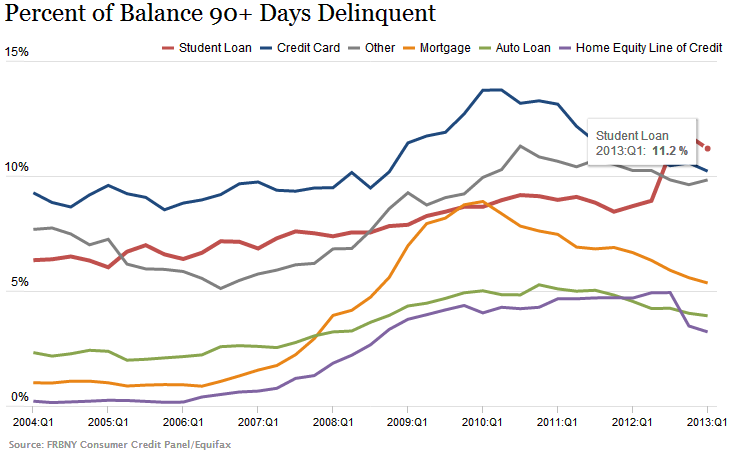
But just because they're not a bubble doesn't mean these levels of indebtedness are not extremely worrying. They are.  These delinquency rates mean that graduates are not getting the kinds of jobs they thought they would get thanks to their expensive degrees.  If higher education is not the key to employment and higher income, then what is?  So far, our nation does not have another answer.


By mybudget360 
June 30, 2013

If the news for college graduates couldn’t get any better.  Our woefully motivated millionaire Congress is unable to figure out what is necessary to stop the doubling of interest rates on student debt.  While the Fed can turn on a dime to rectify zero percent interest rates for member banks, trying to help the youth of the nation well, that is just too hard to do.  Milling around through the data I found that for the first time in history, student debt had the highest delinquency rate of all household debts.  This is a big deal given that Americans now carry over $1 trillion in student debt and most of it is in the hands of the young.  At the nucleus of this argument is that people are going into too much debt to finance their educational pursuits.  Collecting tips at the Olive Garden is not exactly going to payoff that $50,000 in student debt.  How is it that the Fed can subsidize big banks with zero percent rates so they can speculate in real estate and other ventures while college graduates are now faced with the doubling of interest rates?

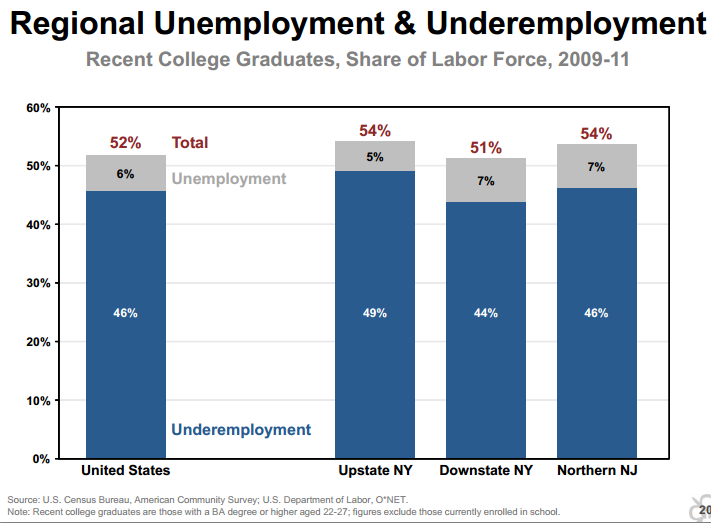
Half of college graduates not utilizing degree

Part of the problem is the voting power (or lack of it) from younger Americans.  Many simply do not vote.  And the baby boomer cohort is guiding many policies through elected officials although they only serve a tiny pizza slice of the baby boomers at that.  So with that said, the voice of the young is largely drowned out by big business and higher education has turned into a very lucrative private-public venture.  With that as our backdrop, half of college graduates are not utilizing their increasingly more expensive degrees:

college graduates underemployed

Half of recent college graduates are either unemployed or underemployed.  And recently many have given up on pursuing careers where their degrees would be utilized and have taken up other jobs.  Other jobs that would have gone to lower skilled workers.  And of course, these workers get pushed down into a lower level of the economic ladder.  And what a shocker that as we go into the various levels of Dante’s Economic Inferno we find that 47.7 million Americans are on food stamps.

The above chart is rather sobering because many recent graduates are leaving school with high levels of debt.  Incomes for many of these graduates are not justifying the sky high rates of tuition at many schools.  Education is still a worthy venture and that is why people continue to go into high levels of debt for this.  Yet our banking system has been rather obsessed with one sector of our economy since the tech bubble burst in the early 2000s.  Real estate has seemed to dominate every big decision in the last decade to the detriment of creating an economy where millions of jobs are added to meet this more educated workforce.  That has clearly not happened.  Colleges are not going to turn their back on willing students with fresh loans in hand.  And I suppose that is the point.  Easy access to debt is like an aphrodisiac for the industry.  Go to any college campus and you will see palatial stadiums and massive buildings.  Do Olympic sized pools make people discover cures for modern diseases quicker?

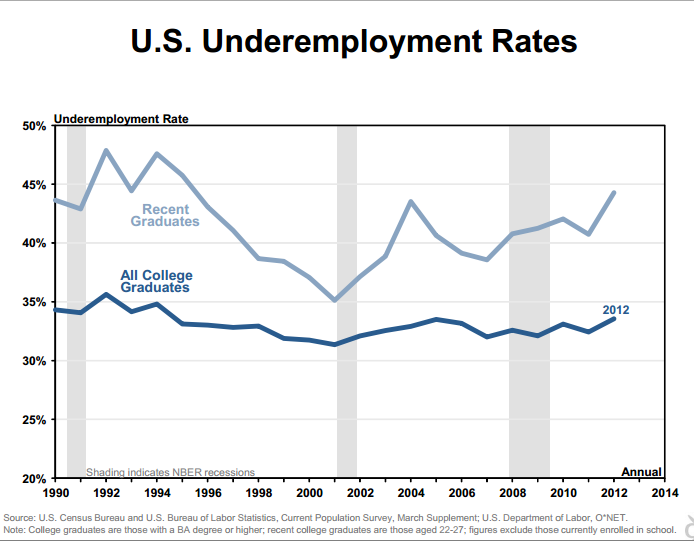
What is even more troubling is that the underemployment rate for recent college graduates has trended up in the last few years while the overall unemployment rate has fallen:

recent college grad data

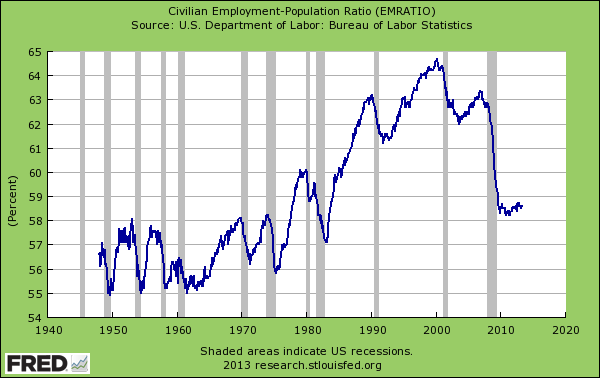
No, we are not looking at a chart of Spain or Greece but a chart of US recent graduates.  A large part of the decline in the unemployment rate has come because the civilian employment population ratio continues to lower:

civilian pop ratio

While many older Americans have dropped off the radar, many recent graduates simply do not have this option.  Many over the last few years have clearly opted to take on jobs that are underutilizing their degrees.  Does that mean they overpaid for their education?  $1 trillion in student debt seems to give us an answer that not only did many overpay, they didn’t even have the funds to afford it in the first place.  Higher tuition would make more sense if wages were also rising but that doesn’t seem to be the case with the new batch of graduates.  And many are falling into student debt quicksand and are unable to pay the loans they now have.

The most delinquent of them all

Student debt before the 2000s hit was typically a safe financial bet.  Delinquencies on student debt reflected this.  Today, we now find ourselves at the precipice of another bubble with student debt having the highest delinquency of any form of household debt:

student loan bad debt

You can see this rate doubling only in the last few years.  Keep in mind this is occurring without the potential doubling of student loan interest rates.  Rates are set to go from 3.4 percent to 6.8 percent if Congress does not act.  Amazingly, they are able to act quickly when it comes to the interest of large banking but to help the young in our nation?  No, let us go on holiday break and see what happens.

The rising delinquency rates are simply the last straw in the student debt bubble.  This is a bubble.  When you have prices soaring without any underlying economic change, you have a big problem on hand.  Keep in mind that what you can afford and the price of something are fully disengaged since the government will lend pretty much whatever is necessary to go to school.  If the cap was $100,000 a year, you can rest assured you will have some for-profits cropping up with $100,000 a year degrees.  Record delinquencies and half of recent graduates working in jobs where a massively expensive degree is not being used does not bode well for higher ed at the moment.  No one has a crystal ball on how this will play out but you can rest assured that something is going to give.  You don’t need a college degree to figure that one out.

Saturday, May 18, 2013

MB360: US student debt grew 284% from 2004-13

The facts behind the mountain of student debt: 13 percent of students owe more than $50,000 and nearly 4 percent owe more than $100,000. Student debt grew by 284 percent from 2004 to 2013.
Posted by mybudget360 
May 18, 2013

Many Americans view a college education as a way to build a better life.  College is seen as an avenue for better prosperity and the ability to pull yourself up beyond your current circumstances.  In fact, after World War II programs like the G.I. Bill allowed many Americans the opportunity to pursue a college degree.  In many cases, the United States at this time developed the largest middle class the world had come to know.  This is still the case today but the economic trends show a shrinking middle class that is largely having a tough time competing in this quickly globalizing economy.  One fact that stands out is that back in 2004, student debt was the smallest portion of all non-housing related debt in the US.  Only a short nine years later, student debt is the largest portion of debt in non-housing related debt.  What happened in this short period of time and what information can we pull from the mountains of student debt information?

Student debt and the decade of massive growth

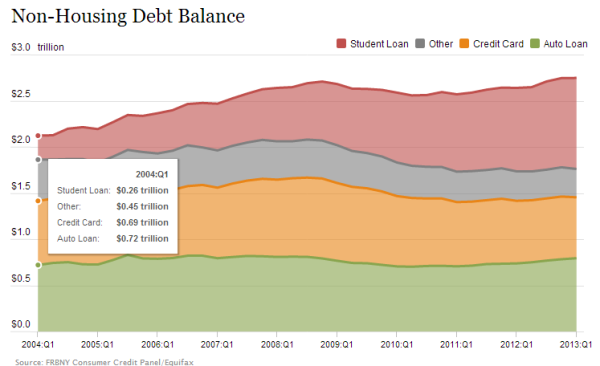
One could argue that every segment of the economy experienced a growth in debt over the last decade.  That is not true.  Let us examine non-housing related debt carefully:

non-housing debt and student debt

Source:  Federal Reserve, Equifax

This is an interesting chart.  What we find is that Auto debt was the largest debt segment in 2004.  This was followed up by credit card debt and then other debt.  Student loan debt at this time was $260 billion.  In total, student debt made up 12 percent of all non-housing related debt back in 2004.

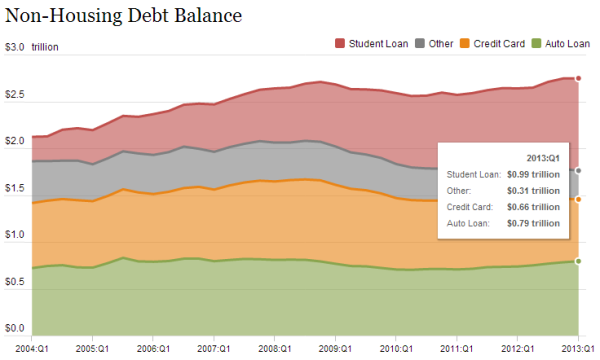
Fast forward to where we stand today:

non-housing debt and student debt 2

Source:  Federal Reserve, Equifax

Student debt is now by far the largest portion of non-housing related debt in our economy.  Student debt is now well above $1 trillion.  The growth of student debt in this short window was 284 percent.  Student debt now makes up a stunning 36 percent of all non-housing related debt.  What is interesting then is when we compare this to the growth of the other segments of non-housing related debt:

Growth between 2004 and 2013
Non-housing related debt
Auto loans:       9%
Other:              -31%
Credit Card:     4.5%
Student Debt:  284%

In essence, nearly all the growth in non-housing related debt over this time has come from student debt growth.  This makes the following data more troubling regarding the amounts of student debt by tiers but also the rising number of delinquencies:

“(NY Times)  According to the Federal Reserve Bank of New York, almost 13 percent of student-loan borrowers of all ages owe more than $50,000, and nearly 4 percent owe more than $100,000. These debts are beyond students’ ability to repay, (especially in our nearly jobless recovery); this is demonstrated by the fact that delinquency and default rates are soaring. Some 17 percent of student-loan borrowers were 90 days or more behind in payments at the end of 2012. When only those in repayment were counted — in other words, not including borrowers who were in loan deferment or forbearance — more than 30 percent were 90 days or more behind. For federal loans taken out in the 2009 fiscal year, three-year default rates exceeded 13 percent.

America is distinctive among advanced industrialized countries in the burden it places on students and their parents for financing higher education. America is also exceptional among comparable countries for the high cost of a college degree, including at public universities. Average tuition, and room and board, at four-year colleges is just short of $22,000 a year, up from under $9,000 (adjusted for inflation) in 1980-81.”

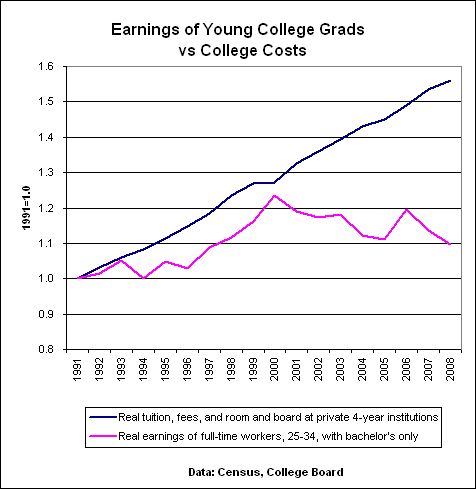
Averages do hide a lot of the facts but what we can deduct is that the 13 percent that owe more than $50,000 and the 4 percent that owe more than $100,000 have largely come in the recent decade.  While the cost of tuition has soared in this short period of time a large part of it has not corresponded to actual earnings:

college grads and earnings

What is interesting about the above chart is that real tuition is up (with new data) by close to 70 percent while real earnings are roughly the same as they were back in 1991.  So over a 20 year period college costs have soared but the return doesn’t seem to justify the rise.  We also have the proliferation of non-profit schools that target lower income Americans and provide them a questionable level of education.  Yet this is only one small part of the larger issue.  The addiction to debt.  We have discussed how this recession has hit young Americans incredibly hard.  In the current marketplace it has become hyper-competitive and expensive while starting salaries have fallen behind when it comes to inflation.  The rising number of delinquencies also shows that many students are simply unable to pay their debts.

If student debt were to grow at the current rate, we would be at $3.84 trillion in student by 2023.  Do you think that is sustainable?  If not, something has to give.