Showing posts with label economic growth. Show all posts

Thursday, August 21, 2014

U.S. economy stinks because of greedy corporations?

Blodget accurately uses the word "greedy" and "short term" to describe how U.S. corporations are acting -- by cutting back staff, freezing most workers' wages, and buying back stock. 

Yet there's another way to look at these trends: from an orthodox business perspective. Indeed, in my finance course in business school, we were taught that corporate decisions such as buying back shares and issuing big dividends may be popular among investors; yet such actions must also be eyed skeptically by long-term investors, since they are a signal that the corporation can currently find no better use of its profit, such as R&D or capital investment.

 Now jump to the "job creators" myth, and you'll understand why this is relevant: every time Wall Street cheers these short-term gains in stock price, U.S. workers are losing out again, because either somebody's not getting hired or somebody's not getting a raise. And this means less consumption and economic activity (about 70 percent of U.S. GDP).  

And this gets back to the idea of depressed aggregate demand, and why the "job creators" myth is bullshit, because the capitalists (people with money) and the corporate owners (shareholders) and officers, when acting rationally in a system where their customers don't have as much money as they once did to buy their products, stop investing and producing as much, because this seems like the sensible thing to do. And they all do this at once. They are prisoners in the same system that wage-earners and consumers inhabit; they're not divorced from it, at least not in the long term. 

So this idea that job creators, if government would only get out of their way and/or cut their taxes, would behave much differently than they are now, is totally bogus and irrational, because although they are at the top, they are not the commanders of the system, nor do they stand apart from it. 

In fact, as Paul Krugman pointed out back in 2010, and just about every business survey since then has supported, lack of demand (sluggish sales) is the key business problem, not taxes or regulation or general "uncertainty."  


By Henry Blodget
August 19, 2014 | Business Insider


GDP Growth
Business Insider, St. Louis Fed
GDP growth.
The U.S. economy is still sputtering. (See GDP growth chart above.)
Why is growth so slow and weak?
One reason is that average American consumers, who account for the vast majority of the spending in the economy, are still strapped.
The reason average American consumers are still strapped, meanwhile, is that America's companies and company owners — the small group of Americans who own and control America's corporations — are hogging a record percentage of the country's wealth for themselves.
In the past five years, American corporations have boosted their profits and share prices by cutting costs (firing people) and buying back stock. As a result, unemployment remains high. And wage growth for the Americans who are lucky enough to be working has been pathetic — the slowest since World War II.
Meanwhile, America's corporations and their owners have never had it better. Corporate profits just hit another all-time high, both in absolute dollars and as a percent of the economy. And U.S. stocks are at record highs.
Scrooge
Even Scrooge would be appalled.
Many people seem confused by this juxtaposition. If corporations and shareholders are doing so well, why is the economy so crappy?
The answer is that one company's wages are other companies' revenues. Americans save almost nothing, so every dollar we earn in wages gets spent on products and services (including, in some cases, those of the companies we work for). The less that American companies pay their workers, the less American consumers have to spend. And the less American consumers have to spend, the slower the economy grows.
This isn't a complex concept. We're all in this together. People make it complicated by casting it as a political issue and inflaming partisan tensions. But it has nothing to do with politics.
Importantly, it doesn't have to be this way.
There's no "law of capitalism" that says that companies have to pay their employees as little as possible. There's no law of capitalism that says companies have to "maximize short-term profits." That's just a story that America's owners made up to justify taking as much of the company's wealth as possible for themselves.
Ironically, this short-term greed on the part of America's owners is most likely reducing their long-term wealth: Companies can't grow profits by cutting costs forever, because their profits can't grow higher than their revenues. At some point, revenue growth needs to accelerate. But that won't happen until companies start sharing more of the wealth they create with the folks who create it — their employees.
Let's go to the charts ...
1) Corporate profit margins just hit another all-time high. Companies are making more per dollar of sales than they ever have before. (Some people are still blaming economic weakness on "too much regulation" and "too many taxes." That's crap. Maybe little companies are getting smothered by regulation and taxes, but big ones certainly aren't. What they're suffering from is a myopic obsession with short-term profits at the expense of long-term value creation.)
Corporate profits
Business Insider, St. Louis Fed

Profits as a percent of the economy.
2) Wages as a percent of the economy just hit another all-time low. Why are corporate profits so high? One reason is that companies are paying employees less than they ever have as a share of GDP. And that, in turn, is one reason the economy is so weak: Those "wages" represent spending power for consumers. And consumer spending is "revenue" for other companies. So the profit obsession is actually starving the rest of the economy of revenue growth.
Wages
Business Insider, St. Louis Fed
Wages as a percent of the economy.
In short, our obsession with "maximizing profits" is creating a country of a few million overlords and 300+ million serfs.
Don't believe it?

Thursday, July 17, 2014

Needless economic damage of the 'sequester'

Just in case you forgot how much damage the idiotic, Tea Party-inspired budget sequestration did to the U.S. economy, here's a reminder: at least $351 billion

"Less austerity in the short term would have meant more growth, less unemployment and an even faster-shrinking deficit in the long term," concludes Mark Gongloff.

We should never again allow conservative debt fetishists to impose their confusion about cause (economic downturn) and effect (rising deficits) on the rest of us.  


By Mark Gongloff
July 16, 2014 | Huffington Post

Austerity is like a bad tattoo: It's going to be with us, causing misery, for years to come.

The broad spending cuts that were the fruits of the Republican Congress' budget obsession of the past few years have already cost the U.S. economy $351 billion in lost economic activity, according to a new study by the Center for American Progress. This austerity will cost a total of $633 billion by the year 2020, according to the study. Here's a chart from CAP to help put it in perspective:

600 billion

"Congress has severely damaged the economy with deep spending cuts in a misguided attempt to solve a short-term debt crisis that simply does not exist," wrote CAP economists Harry Stein and Adam Hersh.

The progressive think tank's analysis is based on the latest budget outlook from the Congressional Budget Office, the nonpartisan congressional research group, which was released on Tuesday.

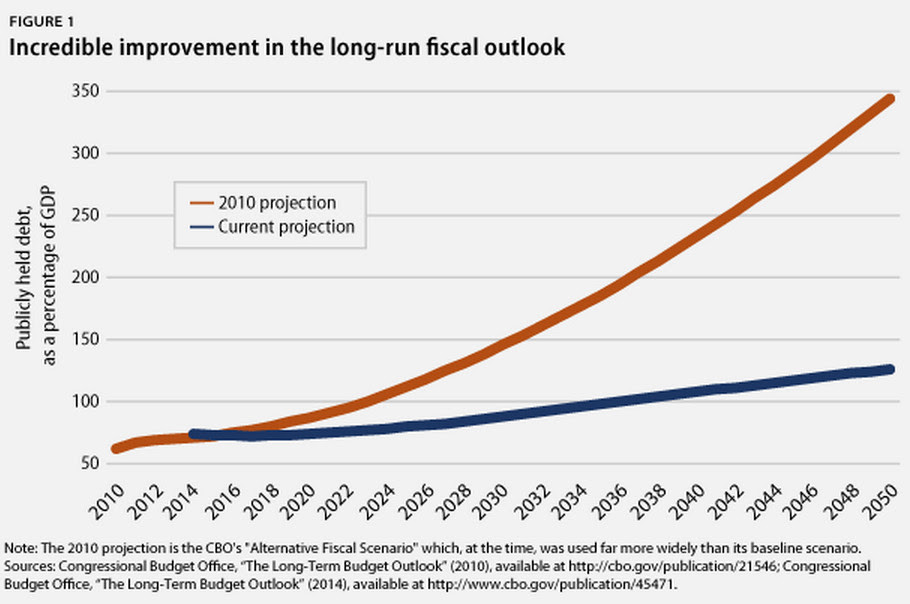
The CBO found that, despite relentless panic about supposedly out-of-control government spending, the long-term path of federal debt has dramatically improved lately. You can see that in this second CAP chart, showing the CBO forecast for the ratio of federal debt to gross domestic product:

debt outlook

Budget cuts have probably helped bring down the long-term debt outlook a bit. But an improving economy has helped much more, by raising tax revenue and dramatically shrinking the government's annual budget deficit.

The CAP study is the latest in a series of studies tallying the costs of austerity. The long and short of it: Less austerity in the short term would have meant more growth, less unemployment and an even faster-shrinking deficit in the long term.

Tuesday, June 24, 2014

Russia's corrupt resource economy behaves opposite Western expectations

It runs absolutely counter to our Western intuition and sense of justice, but as Vladislav Inozemtsev points out, Russia's corrupt officials actually benefit in times of global economic crisis, both in terms of their personal wealth and public support.

Concludes Prof. Inozemtsev in this op-ed in the Moscow Times [emphasis mine]:

Today's Russia is not a normal country. A significant portion of people who can adequately assess the situation either left the country or are leaving it right now. Many entrepreneurs sold their businesses to bureaucrats and pulled money out of the country, realizing the futility of their labors.

[...]   Of course, the problems are piling up — so sometimes they will come out. But both the speciality of Russia's situation and its difference from these in democratic market economies lies in the fact that the first alarm signals will sound when it will be too late to react. We will probably see a repetition of the dramatic events of the late 1980s — but, of course, this may not happen for awhile. Time during which economic problems will not preoccupy the Russian president — leaving him free to surprise the world once and again with his political follies.

It's well worth reading in its entirety to understand today's very strange Russia!


By Vladislav Inozemtsev
June 24, 2014 | The Moscow Times

Thursday, June 19, 2014

The backwards South is moving backward

It's strange and pathetic how the today's Southern states promotes themselves to businesses and investors as a kind of third-world enclave within the United States -- not only low-tax but also low-wage, and of course no unions.

Maybe that strategy is OK for Bangladesh, but touting oneself as low-wage is not a long-term winning strategy for the US of A.  Lower wages and incomes mean a lower tax base, leading to poorer schools, less infrastructure and hence weaker long-term economic growth.

Indeed, the poorest and most miserable U.S. states are located in the South.


By Nelson Lichtenstein
June 18, 2014 | Reuters

We used to call it the “New South.” That was the era after Reconstruction and before the Civil Rights laws — when the states of the old Confederacy seemed most determined to preserve a social and economic order that encouraged low-wage industrialization as they fought to maintain Jim Crow.

What was then distinctive about the South had almost as much to do with economic inequality as racial segregation. Between roughly 1877 and 1965, the region was marked by low-wages, little government, short lives and lousy health — not just for African-Americans but for white workers and farmers.

The Civil Rights revolution and the rise of an economically dynamic Sun Belt in the 1970s and ‘80s seemed to end that oppressive and insular era. The Research Triangle in North Carolina, for example, has more in common with California’s Silicon Valley than with Rust Belt manufacturing. The distinctive American region known as the South had truly begun to vanish.

This is the thesis of economic historian Gavin Wright’s new book on the economic consequences of the civil rights revolution,Sharing the Prize. Ending segregation, Wright argues, improved the economic and social status of both white and black workers The South became far less distinctive as wages and government-provided benefits increased to roughly the national level.

But the New South has returned with a vengeance, led by a ruling white caste now putting in place policies likely to create a vast economic and social gap between most Southern states and those in the North, upper Midwest and Pacific region. As in the late 19th century, the Southern elite appears to believe that the only way their region can persuade companies to relocate there is by taking the low road: keeping wages down and social benefits skimpy. They seem to regard any trade union as the vanguard of a Northern army of occupation.  

Exhibit A is the refusal of every Southern state except Kentucky and Arkansas to expand Medicaid under the Affordable Care Act. Senator David Vitter (R-La.), running to replace Bobby Jindal as Louisiana’s governor, made headlines Monday when he announced he would consider adopting the Medicaid expansion.

In 2012 the Supreme Court gave states the right to back out of this part of Obamacare. The South rushed to take this opportunity — despite the loss of billions in federal dollars. Now 5 million poor Southerners are consigned to health insurance purgatory

The Republican Party as a whole has made opposition to Obamacare virtually a fetish. But outside the South, Republican governors from Arizona and Nevada in the West to Iowa, Ohio, and New Jersey further East, have seen the economic logic and social utility of taking the federal money. After the 2014 elections, when Democrats look likely to oust Republicans from statehouses in Pennsylvania and Maine, those states will do the same. 

Southern states also keep wages low by neglecting to raise their state minimum wage standards. In the North and West, a movement to dramatically increase wages — to $10, $12 or even $15 dollars an hour — has caught fire. Seattle just mandated a $15 minimum wage that will kick in over the next few years.

Today 21 states have raised minimum wages higher than that of the federal standard of $7.25 an hour. But only two of these states, Missouri and Florida, border on the South.  As in the New South era, when textile factories were enticed to flee the North for the low-wage Piedmont region, Southern states now trumpet not just low taxes and an absence of trade unions, but low wages.

Although Oklahoma joined the Union in 1907, it immediately joined the ranks of the Jim Crow South with its strong segregation and anti-union policies. This continues today. In April, for example, when Oklahoma City residents sought to put a municipal wage increase on the November ballot, the state legislature quickly enacted a law banning any city or town from raising the local minimum wage or requiring that employees have a right to sick days or vacation, either paid or unpaid.

Of course, such regressive social policies, including voting rights limitations, are supported by a fierce white partisanship. The solid South has returned in full force. Black voters there are overwhelmingly Democratic, whites of almost every income level equally determined to vote Republican.

The presence of an African-American in the White House plays a large role in this racial-political polarization on the ground in Dixie. But not even Southern-born white Democrats, like former President Bill Clinton and former Vice President Al Gore, have been able to transcend this Southern partisanship. Despite for their cultural affinities and Southern accents, they could not persuade Southern whites to vote Democratic.

This is, however, not just a product of racial fears and resentments. Instead it appears to reflect an increasingly inbred Southern hostility to the exercise of economic regulatory power on virtually any level.  As in the 19th century, many in the South, including a considerable proportion of the white working-class, have been persuaded that the federal government is their enemy.   

As in the New South era, Southern whites, both elite and plebian, have adopted an insular and defensive posture toward the rest of the nation and toward newcomers in their own region. Echoing the Jim Crow election laws promulgated by Southern states at the turn of the 20th century, the new wave of 21st century voting restrictions promise to sharply curb the Southern franchise, white, black, and brown.

The new New South rejects not only the cosmopolitanism of a multiracial, religiously pluralist society, but the legitimacy of government, both federal and state, that seeks to ameliorate the poverty and inequality that has been a hallmark of Southern distinctiveness for more than two centuries.

The Civil War has yet to be won.

Tuesday, February 4, 2014

'Liberal' media lies: Obamacare will cost 2 million jobs

So did the CBO really mean to forecast that 2 million people would lose their jobs because of Obamacare? No. But that's how the mainstream media -- including the "liberal" axis at the New York Times and Washington Post reported it.

As Weinstein clarifies, here's what the CBO actually said:

CBO estimates that the ACA will reduce the total number of hours worked, on net, by about 1.5 percent to 2.0 percent during the period from 2017 to 2024, almost entirely because workers will choose to supply less labor—given the new taxes and other incentives they will face and the financial benefits some will receive.

Is that just wonkish liberal-progressive spin?  Is that just "figures lie, and liars figure?"  No again:

When workers no longer have to rely on full-time employers to get affordable health care, they suddenly have the freedom to not work full-time. That could mean people stuck in crappy hourly jobs 40 hours a week at, say, the local big-box store. Or creatives jammed in underpaying urban admin assistant jobs. Indeed, the CBO adds:

Because the largest declines in labor supply will probably occur among lower-wage workers… the impact on the overall economy will be proportionally smaller than the reduction in hours worked.

Weinstein sums it up [emphasis mine]:

The problem here is truly philosophical. It is ideological. It is rooted in the two Americas' distressingly divergent answers to a simple question: What is a job for?

For pundits and pointy-headed analysts, it's to keep The Economy and Growth flowing. That is its good. That is its end. Workers are the means. For most workers (the vast majority of whom aren't leaving their families and schlepping through megastorms to cubicles or factories for the love), the job is the means to a different, individualized end: the ability to buy one's own way, to keep loved ones fed and happy and healthy, to stave off poverty.

So what the CBO said today, in essence, was that if this Obamacare thing works out, people won't need to work full-time jobs just to keep health care benefits. They may actually be able to spend more time with those families. They may be able to freelance, to split hours between two parents rather than having one stay-at-home parent and one full-time earner. They may be able to take a chance on that novel or Etsy shop, instead of staying at the office until death.

That's not what conservatives hear, though, because that's not what conservatives care about. Their concern for people is subverted by their concern for commercial output, or economic abstractions that appear to impact commercial output.

People are real. They are not economic abstractions. And health care (and Medicare and food stamps, for that matter) is not single-sided accounting, with all costs and liabilities and no assets or benefits.  Health insurance that is not tied to employment facilitates Americans' labor mobility, unleashes their creativity and risk-taking, simply because they don't have to make one of the most important decisions in life -- where to work -- based solely on where they can get decent health insurance.  


By Adam Weinstein
February 5, 2014 | Gawker


UPDATE (02.082014): Check out Matt Taibbi's somewhat nuanced take on the media flap over the CBO report: "Latest Health Care Flap Shows Media at its Most Boring."

Friday, August 30, 2013

The unglorious truth about rapid economic development

About a month ago, I forwarded to several friends in the development biz this op-ed written by Zack Exley in reply to a controversial op-ed by scion Peter Buffett against charitable "conscience laundering," i.e. the $316 billion annual "business" of philanthropy.

I asked for their reactions.  I got none.

Now I think I know why.  Because it makes development professionals seem inconsequential. For that matter, it makes the World Bank, NGOs, and a lot of economic literature seem inconsequential.

Here's Exley's "secret" to how poor developing countries in the 20th century became rich and developed [emphasis mine]:

How did they pull billions out of poverty so quickly? Unfortunately, the answer is totally unfashionable and will never, ever be discussed at hipster social venture forums. They all had one thing in common: the people in charge -- whether they were social democrats, conservative nationalists, communists or military dictators -- carried out programs of rapid economic development designed to give most people access to means of making a living.

But how did that do that? They built factories, railroads, universities and everything else required to make the things and do the things that go into a decent living (or were valuable enough to trade for them). Communists and dictatorships used various forms of force -- often brutal. Democrats and republicans (small d and small r) used the market and public-private partnerships. By hook or by crook, wherever eliminating poverty was one of the top few national priorities, it was eliminated.

You know, I can't think of a single counter example.  I can't think of a single country that sincerely tried to invest in rapid economic expansion and failed to achieve it. The agent isn't important, it's the action. The action always works.    

In international development, we're always chipping away at the edges, dealing with obstinate or corrupt bureaucrats and elected officials who won't take our advice, donor agencies engaged in external turf battles and internal pissing matches, and apathetic communities who don't believe in us, or believe that their leaders will listen to us.  And yet to effect massive, dramatic economic development, donors don't matter.  It's the "locals" (to use the condescending development vernacular) that must be onboard, from the small towns up to the president or prime minister. And when that happens, so do economic miracles. 

Ideology and political economy seem irrelevant, I hate to say it.  

Go ahead, somebody prove me wrong!  


By Zack Exley
July 29, 2013 | Huffington Post

Saturday, June 29, 2013

Temp Nation

We need a national Temp Workers Bill of Rights. These are the most vulnerable people in our country, people who really want to work, and they need protection under the law.

Compare today's Temp Nation to what we had from 1950 to about 1980, with a blue-collar U.S. middle class with steady wages, hours and benefits like medical insurance and a pension.  Those people and those jobs made America the greatest economy the world has ever known.  And we're shipping those jobs overseas and replacing the ones that are left with temps.  America cannot sustain its greatness in this way.  We need to think bigger and not leave the "free market" to destroy our labor force and middle class.  

Check it out [emphasis mine]:

Across America, temporary work has become a mainstay of the economy, leading to the proliferation of what researchers have begun to call “temp towns.” They are often dense Latino neighborhoods teeming with temp agencies. Or they are cities where it has become nearly impossible even for whites and African-Americans with vocational training to find factory and warehouse work without first being directed to a temp firm.

In June, the Labor Department reported that the nation had more temp workers than ever before: 2.7 million. Overall, almost one-fifth of the total job growth since the recession ended in mid-2009 has been in the temp sector, federal data shows. But according to the American Staffing Association, the temp industry’s trade group, the pool is even larger: Every year, a tenth of all U.S. workers finds a job at a staffing agency.

The proportion of temp workers in the labor force reached its peak in early 2000 before the 2001 slump and then the Great Recession. But as the economy continues its slow, uneven recovery, temp work is roaring back 10 times faster than private-sector employment as a whole – a pace “exceeding even the dramatic run-up of the early 1990s,” according to the staffing association.

The overwhelming majority of that growth has come in blue-collar work in factories and warehouses, as the temp industry sheds the Kelly Girl image of the past. Last year, more than one in every 20 blue-collar workers was a temp.

And wanna talk about racial inequality?  Blacks and Latinos each make up 20 percent of all temp workers in the U.S., or 40 percent, total.  As conservatives like to note, minorities make up a disproportionate number of welfare recipients, relative to their share of the U.S. population.  Well, the same is true of temp and minimum-wage laborers.  These are poor and minority Americans who want to work and they are forced to live on the knife edge of poverty, with constant insecurity.  We must do better by those who want to work!


By Michael Grabell
June 27, 2013 | Pro Publica

Thursday, June 27, 2013

Inequality should matter to conservatives, too

We all know that conservatives don't worry about equality of outcomes; they care about equality of opportunity.  Actually, they don't care about outcomes at all; they only care about establishing rules of the game.  That's a values question, that's conservatives moral bent, although personally I think they're wrong.  We'll never agree.

However, what Bernstein's and other economists' research is showing us is that growing income equality actually diminishes equality of opportunity.  Bernstein talks about it herehereherehere.  This should worry conservatives.  The economic playing field will never be level; but we should be concerned when it's getting more unbalanced every year.

In addition, Bernstein plans to prove that income inequality leads to lower economic growthThat should concern us all, including deficit hawks who want to shore up our federal deficit.  


By Jared Bernstein
June 26, 2013 | Huffington Post

Tuesday, June 25, 2013

No correlation between cap. gains tax and investment

Sometimes common sense is not so common... or correct.  Quantitative research, i.e. reality, often contradicts our intuitive sense of they way things ought to work, but actually don't.  Such is the case with capital gains tax rates, real investment and economic growth, as proven by tax law professor Chris Sanchirico of the University of Pennsylvania and Wharton in a recent paper [emphasis mine]: 

On the surface, the growth argument against capital income taxes seems clear and compelling. And many policymakers and pundits—on both sides of the aisle—appear to regard it as common sense. 

A very different picture emerges, however, from the academic research on taxes and growth. Scholarly evidence on the growth argument against capital income taxation is mixed at best. Indeed, it would not be unreasonable to conclude, based on the best available theory and data, that the growth argument has no real basis.

[...]  Compelling intuitions tend to melt away on close inspection, and the data tell no consistent story. When the negative growth effects of offsetting increases in labor income taxes or government borrowing are also taken into account, uncertainty begins to shade into doubt. Attempting to spur economic growth with tax preferences for capital income may be like trying to repair one side of the roof with shingles from the other

Regarding the non-correlation between capital gains and real investment, here's an historical illustration by economist Jared Bernstein:


If it seems to your untrained eye that there is no relationship between the red and blue lines, your eye is correct.  

And if you care about growing income inequality in the U.S. -- most conservatives don't -- then you must note the conclusion of Thomas Hungerford of the Congressional Research Service: "The reason income inequality has been increasing has been the rising income going to the top one percent.  Most of that has come in capital gains and dividends."